
Where Wealth Meets Wellness: The Rise of Olive Oil Travel
Writer: Aynur Tattersall
There was a time when the world’s wealthiest individuals measured distinction through art collections.
Then came superyachts, private islands, space tourism, personal health advisers and multimillion-dollar investments in longevity science.
Today, another symbol of modern luxury is quietly emerging.
Olive oil.
Not because it is fashionable, but because it sits at the intersection of two of the most powerful aspirations of our age: health and longevity.
The ultra-wealthy no longer seek merely to live well.
They seek to live longer—and better.
When Health Becomes the Ultimate Luxury
Over the past decade, billions have flowed into the rapidly expanding longevity economy. From cellular regeneration and preventative medicine to personalised nutrition and age-reversal research, the pursuit of a longer lifespan has become one of the defining investment themes of our time.
Yet amid the laboratories, supplements and biotech start-ups, many are rediscovering something far older.
The Mediterranean way of life.
At the heart of it lies extra virgin olive oil.
Once regarded as a simple pantry staple, it is increasingly viewed as one of the world’s most valuable natural health assets—a product whose reputation is built not only on flavour but on decades of scientific research linking it to cardiovascular health, reduced inflammation and healthy ageing.
For a growing number of affluent travellers, understanding olive oil has become as important as understanding wine once was.
As a result, olive groves are becoming destinations in their own right.
Across Tuscany, Andalusia, Crete and the Peloponnese, luxury travellers are increasingly seeking immersive olive oil experiences: harvests, tastings, masterclasses and intimate encounters with producers whose work reflects generations of agricultural knowledge.
The New Investment Landscape
For some, however, tasting is only the beginning.
Around the world, entrepreneurs, investors and business leaders are quietly acquiring olive estates, restoring historic groves and building premium olive oil brands.
What they are purchasing is not merely farmland.
They are investing in a philosophy.
A slower rhythm of life.
A connection to nature.
A product associated with vitality, wellbeing and the possibility of ageing with grace.
In an era increasingly defined by wellness, olive oil has become something far greater than a commodity.
It has become cultural capital.
A Turkish Story with Global Ambitions
Turkey is exceptionally well positioned to benefit from this shift.
And few places illustrate the opportunity more compellingly than Milas.
On a recent visit to the region, I found myself at ORO di Milas, a producer whose award-winning oils have attracted international attention and whose ambitions extend far beyond production alone.
The project was founded by Emine Colin and her husband, Mark Colin, who envisioned creating not simply an exceptional olive oil, but a destination capable of introducing international visitors to the richness of Turkish olive culture.
What they have built is remarkably timely.
Nestled among centuries-old olive groves between Bodrum and Milas, ORO di Milas has evolved into a place where gastronomy, agriculture, education and hospitality converge.
The vision is brought to life through the dedication of Nilgün Eren, whose commitment to introducing Turkish olive oil to an international audience is impossible to overlook. Alongside her, Özlem Karakaş has helped shape an environment that feels both polished and deeply personal.
The result is striking.
Visitors arrive curious about olive oil.
They leave talking about Milas.
Beyond Tasting
What distinguishes experiences such as these is that they move beyond consumption.
Guests are invited to understand.
They learn what separates extra virgin olive oil from industrially refined alternatives. They explore the journey from grove to mill and discover how climate, soil and cultivation influence flavour and quality.
Then they cook.
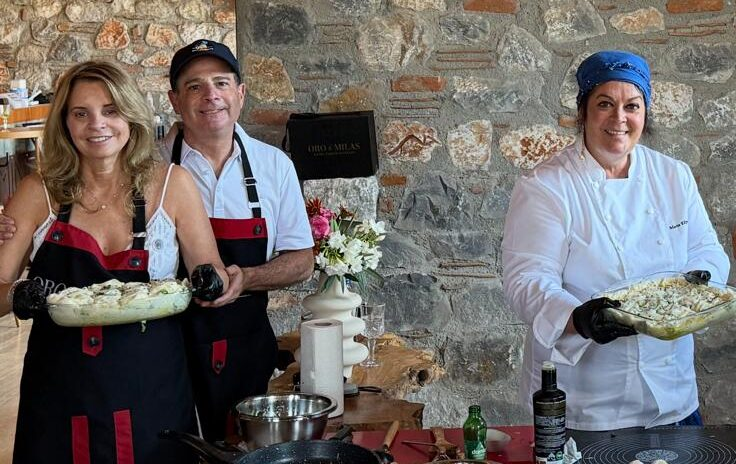
Through workshops led by celebrated food writer and culinary expert Maria Ekmekçioğlu, visitors are introduced not only to Turkish cuisine but also to the broader principles of Mediterranean living.
Increasingly, many of these guests arrive from luxury cruise ships docking along the Turkish coast.
Demand has become so strong that some travellers plan their itineraries specifically around the experience.
Here, they do far more than sample olive oil.
They prepare traditional Turkish dishes, learn the fundamentals of olive oil tasting and gain a deeper appreciation for the role that food culture plays in health and longevity.
For many international visitors, it becomes one of the defining moments of their journey through Turkey.
And at the end of the experience, everyone gathers around the same table.
Which, perhaps, is the point.
The Evolution of Luxury
Luxury is changing.
The old markers remain, of course. The yachts are still there. So are the private jets and the exclusive addresses.
But increasingly, the most sophisticated luxury experiences are those that offer knowledge rather than status.
Authenticity rather than spectacle.
Connection rather than display.
One American investor I met during my visit confessed that he had never truly understood the difference between extra virgin olive oil and ordinary cooking oils until that day.
His astonishment was genuine.
Like many consumers, he had viewed olive oil simply as an ingredient.
Yet the finest olive oils are expressions of place.
They capture landscape, climate, history and craftsmanship in a single product.
Much as wine once transformed rural regions into international destinations, olive oil now appears poised to do the same.
Beneath the Olive Trees
Perhaps this explains why some of the world’s wealthiest individuals are quietly turning their attention towards olive groves.
Not because olive oil is the latest trend.
But because it represents something increasingly rare.
A product where pleasure and wellbeing meet.
A luxury that feels both ancient and relevant.
A reminder that the most valuable investments are not always financial.
Sometimes they are measured in quality of life.
What I witnessed in Milas was not simply the success of a premium olive oil producer.
It was a glimpse into the future of luxury travel.
And that future may well be written not on the decks of superyachts or in the laboratories of Silicon Valley, but beneath the shade of olive trees.


Comments